Borobudur Temple Interior: Exploring the Structure and Sacred Design

The Borobudur temple interior offers a fascinating perspective on one of Indonesia’s most important Buddhist monuments. Rather than having conventional rooms like a palace or museum, Borobudur is designed as a monumental structure that visitors explore by moving through terraces, galleries, platforms, and stupas.
Understanding the interior structure helps travelers appreciate how architecture, sculpture, and Buddhist symbolism work together throughout the monument.
Understanding Borobudur’s Interior
Borobudur was constructed in Central Java between the eighth and ninth centuries. Its design consists of multiple levels that gradually lead visitors upward toward the main stupa.
The monument has five square terraces followed by three circular platforms. A large central stupa crowns the structure. This arrangement creates a carefully planned journey from the lower sections toward the highest level.
For travelers who want to understand the structure in greater detail, this Borobudur inside guide provides additional information about the monument’s interior features and spiritual meaning.
Walking Through the Temple Galleries
One of the most important features of the Borobudur temple interior is its series of galleries. Visitors move around the square terraces while following pathways bordered by walls and balustrades.
These galleries contain extensive relief panels carved into the stone. The reliefs depict different scenes connected with Buddhist teachings, stories, and aspects of life.
Walking through the galleries therefore provides more than an architectural experience. The carved panels create a visual narrative that visitors can gradually discover while moving around the monument.
Exploring the Relief Panels
The reliefs are among the most remarkable elements found throughout Borobudur. UNESCO records that the walls and balustrades contain approximately 2,500 square meters of low reliefs. citeturn0search0
The panels contain a variety of scenes and figures. Some portray Buddhist stories, while others depict people, animals, plants, buildings, and activities associated with historical Javanese life.
Because the reliefs are positioned along the galleries, visitors encounter them as part of their physical journey through the monument.
The Circular Upper Platforms
After completing the square galleries, visitors reach the circular platforms. This section creates a noticeable change in the appearance of the Borobudur temple interior.
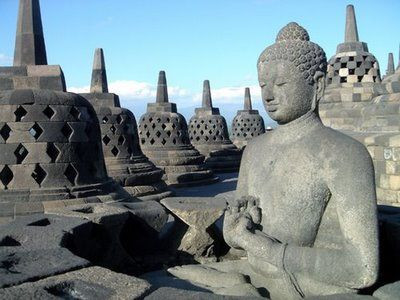
The walls and dense relief decoration of the lower levels give way to a more open architectural environment. Seventy-two perforated stupas are arranged across the three circular platforms. Each contains a Buddha statue. citeturn0search0
The transition from detailed reliefs to the simpler circular platforms creates a strong visual contrast.
Buddha Statues Inside the Stupas
The perforated stupas are among Borobudur’s most recognizable features. Their lattice-like stone designs allow visitors to see Buddha figures positioned inside.
These stupas are arranged around the central monument and form an important part of the upper structure.
From certain viewpoints, the Buddha statues can be seen through the openings in the stupas. This creates a distinctive combination of stone geometry and Buddhist imagery.
The Central Stupa
At the highest point stands the main stupa. Unlike the surrounding perforated stupas, the central stupa has a solid appearance and dominates the uppermost part of the monument.
Its position at the summit emphasizes the vertical organization of Borobudur. The structure gradually changes from detailed narrative reliefs at the lower levels to more open and simplified forms above.
This progression is closely connected with the Buddhist cosmological concept represented through Borobudur’s architecture. citeturn0search0
Understanding the Interior as a Journey
The Borobudur temple interior should not be understood simply as an enclosed space. Instead, the monument is experienced through movement.
Visitors begin at the lower levels and gradually ascend through the galleries before reaching the circular platforms and central stupa.
This physical journey creates a connection between architecture and Buddhist symbolism. Each level contributes to the overall experience of moving toward a higher spiritual state.
Planning Your Borobudur Visit
Visitors interested in the interior structure should allow enough time to observe the reliefs rather than rushing toward the upper platforms.
Look closely at the stone carvings and architectural details along the galleries. Comfortable footwear is also useful because exploring the monument involves walking and climbing multiple levels.
Travelers planning a wider cultural journey through Central Java can also consider Borobudur Tours when organizing their itinerary.
Discover Borobudur From the Inside
Exploring the Borobudur temple interior reveals how carefully the monument combines architecture, reliefs, Buddha statues, and stupas. Its galleries guide visitors through a visual and physical journey, while the upper platforms create a more open and contemplative environment.
For travelers interested in Buddhist heritage, architecture, and Indonesian history, examining Borobudur from within provides a deeper appreciation of why this monument remains an extraordinary cultural landmark.
